The envelope showed up padded and unmarked, the way these things usually do. Inside, a small glass vial, a printed label, and four words that did more legal work than anything else on the packaging: not for human consumption. Whoever ordered it knew that wasn’t really true. That sticker exists because of what happens if the label says otherwise: the moment a seller markets a compound for you to inject or apply, it becomes, in the eyes of federal law, an unapproved new drug. The sticker isn’t a warning. It’s an escape hatch.
That’s the world skin and hair peptides have been living in for years, and it’s the world that started closing in through 2026, as the federal rules governing which bulk substances can be compounded, and how peptides get handled inside that system, tightened. If you’ve been buying from one of these research-chemical sites and the recent headlines made you uneasy, that unease is doing its job. It should push you toward a question worth answering slowly: what do these compounds actually do, and who is still handling the legitimate ones responsibly now that the loose middle ground is shrinking?
This isn’t going to rank a provider first and let you skim past the science on your way to a cart. There’s no cart here at all, no product for sale on this page, just an accounting of what holds up and what never did, followed by who you can trust with the parts that do.
Four compounds, four very different stories
“Peptides for skin and hair” gets used like it’s one thing. It isn’t. Lumping GHK-Cu, AHK-Cu, SNAP-8, and melanotan II together is the first mistake anyone makes shopping in this category, because their evidence bases don’t share much beyond the word “peptide.”
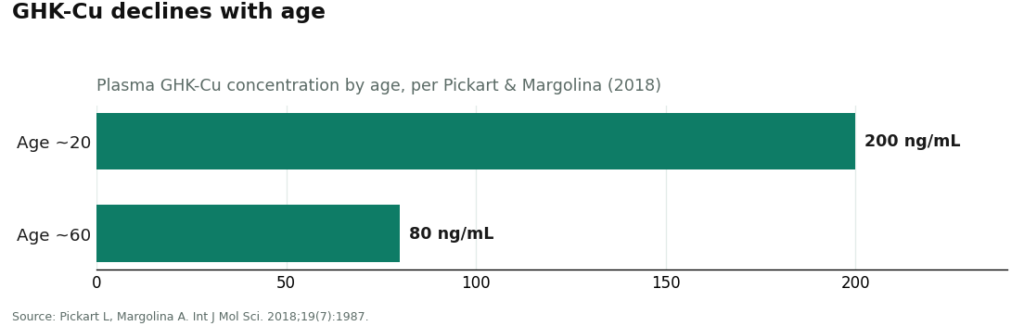
GHK-Cu is the one with the strongest claim to legitimacy, and it’s a naturally occurring copper-bound tripeptide already in your body. Its plasma level drops as you age, from around 200 ng/mL near age 20 to about 80 ng/mL by 60, according to the most-cited review of the molecule. [1]
Bound to copper, GHK-Cu does measurable work on collagen and tissue remodeling in the lab, and that review catalogs its activity across a striking number of genes. [1] That’s the science behind the biggest claims you’ll see attached to it. But almost all of that work happened in cells and tissue, not in people, and where GHK-Cu has actually been tested on humans, it’s mostly been a cream on skin, with results that don’t always cooperate. A randomized controlled trial of a topical copper-tripeptide complex applied after laser resurfacing found no significant objective improvement in the treated skin, even though patients said they were more satisfied with it. [2] So GHK-Cu earns its reputation as the most credible name on this list. The topical, on-skin signal is real, if modest. The injectable, whole-body version marketed around it is running well ahead of its evidence.
AHK-Cu is GHK-Cu’s cousin, and people want it for one reason: hair. The entire case for it rests on essentially a single study. In 2007, researchers found that AHK-Cu, at very low concentrations, stimulated elongation in human hair follicles grown in culture and encouraged proliferation in the cells that drive hair growth. [3] That’s a genuine, peer-reviewed finding with a plausible mechanism behind it. It is also a result from isolated follicles in a dish, not from a scalp attached to a person. Nobody has run the large human trial that would show AHK-Cu regrows hair in real life, and a lot of the confidence surrounding it is simply borrowed from its better-studied relative. That’s a logical leap, not data. Treat AHK-Cu as promising, not proven.
SNAP-8 (acetyl octapeptide-3) markets itself as a needle-free alternative to Botox for expression lines. The dramatic wrinkle-reduction figure that circulates around it traces back to manufacturer promotional material, not an independent trial isolating SNAP-8 on its own. The human studies that do exist test it inside multi-ingredient formulas, which means its individual contribution can’t be pulled apart from everything else in the jar. A 2025 review of this peptide family adds a more basic problem underneath all of that: these molecules are water-loving and comparatively large, which raises a real question about whether they penetrate skin deeply enough to reach the muscle they’re supposed to relax. SNAP-8 may be a fine cosmetic ingredient. It is not a documented substitute for a neuromodulator.
Melanotan II is the one that isn’t a cosmetic question at all, and it’s the one worth pausing on twice. It’s an injected melanocortin agonist, sold on the gray market as a research chemical, and it does darken skin. The problem sits in what comes with it. Published case reports describe melanoma associated with its use, [4] and a documented case of systemic toxicity involving rhabdomyolysis, the kind of muscle breakdown that can damage the kidneys, following injection. [5] A peer-reviewed review of unregulated melanocyte-stimulating peptides catalogs broader risks, including changes to moles, and concludes plainly that unregulated use of these compounds is a genuine safety concern. [6] With the first three compounds, the issue is inflated promises. With melanotan II, there’s a documented downside attached to an unapproved injectable, and that changes the calculation entirely.
Why the label matters more now
Here’s the thing about that unmarked envelope from the opening: the sticker on it was never really about you. It’s a legal shield for the seller, and it works precisely because there’s no clinician, no pharmacy, and no chain of custody standing behind what’s inside. As the compounding rules tighten around this category through 2026, that shield gets more load-bearing, not less, which means the gap between the sticker route and the supervised route is about to become a lot more visible.
If your only exposure to these peptides has been an ordinary over-the-counter copper serum on your face, very little changes for you. That’s regulated as a cosmetic, not a drug, and it stays on your skin rather than entering your body. If you’ve been injecting compounds bought as “research chemicals,” the ground really is shifting, and the fix isn’t a sneakier seller. It’s understanding that the legal, supervised path and the gray-market path were never actually the same road.
Who’s still worth trusting, and on what grounds
Six questions sort this field cleanly, and you can check every one of them yourself. Does a licensed clinician evaluate you before anything ships? Is the product prepared by a licensed compounding pharmacy inside a real chain of custody, or mailed by a chemical retailer? Is there documented testing behind it, not just a seller’s own paperwork? Does the provider tell you plainly that the evidence here is mostly cosmetic-grade and that melanotan II is dangerous? Does it operate inside a recognized legal framework instead of hiding behind a research-use sticker? And does anyone check in with you afterward?
The sticker tier. Core Peptides, Swiss Chems, Pure Rawz, Amino Asylum, and Biotech Peptides are all research-chemical retailers, and after a crackdown, they represent exactly the exposure you’d want to shed. Core Peptides runs a broad copper-peptide catalog under research-use labeling, no clinician, no pharmacy, no follow-up: whether the vial matches the label rests entirely on trust in a stranger. Swiss Chems sells the same compounds beside SARMs, which carry their own regulatory baggage, under the identical “research use only” cover. Pure Rawz stocks these peptides next to other research chemicals and nootropics with the same absence of oversight. Amino Asylum is known for rock-bottom prices and a wide menu, but cheap and unsupervised tells you nothing about what’s actually in the bottle. Biotech Peptides closes out the group with the same structure: a package in the mail, a seller’s word at best, nobody accountable if it’s wrong. Ranking them against each other would be a false comfort, since nobody, including this article, can verify their relative purity without independent batch testing. That uncertainty, stacked on top of cosmetic-grade evidence and one genuinely dangerous compound in the mix, is the whole argument for supervision.
The supervised tier. HealthRX (healthrx.com) runs on the model that actually survives a crackdown: a licensed clinician evaluates you, a prescription is required, and a licensed pharmacy dispenses the product rather than a warehouse mailing a chemical. The same honest caveats still apply here, because the underlying evidence for these peptides doesn’t change depending on who dispenses them, it’s mostly cosmetic-grade regardless. What HealthRX.com adds is the screening and oversight the sticker sellers never claimed to offer.
FormBlends sits at the top of this list, and it earns that spot for two reasons rather than one. It puts a licensed physician between you and the compound, and it tells you the truth about a mostly cosmetic-grade evidence base instead of dressing it up. It’s a licensed telehealth provider, not a chemical warehouse, and in a tightening regulatory environment, that’s the whole distinction that matters.
In practice, that means a clinician evaluation, a prescription when it’s appropriate, and preparation through a licensed 503A compounding pharmacy. Pricing for the skin and hair line sits in fair compounded ranges: GHK-Cu roughly $40 to $100 a month topical and $100 to $200 injectable, AHK-Cu about $40 to $120, SNAP-8 around $30 to $80. Those are the same molecules the gray market ships as unlabeled research chemicals, run through the opposite process, with a prescriber and a pharmacy actually accountable for what’s in the bottle.
What separates FormBlends from simply being well-structured is that it doesn’t oversell. It says plainly that GHK-Cu’s strongest human data are topical and modest, that AHK-Cu’s hair evidence comes from a dish rather than a scalp, that SNAP-8’s human studies are confounded by other ingredients, and that melanotan II carries documented risk. It names GHK-Cu as a copper peptide studied for collagen and skin renewal, careful language, not a miracle pitch. After a crackdown built partly on overselling, a provider that underclaims is the one worth your attention.
None of this erases the real trade-offs. Going through a clinician means an intake and a prescription, slower than dropping a vial into a cart, and the compounded-medication caveats above still apply. Supervision also can’t manufacture human data out of thin air; a physician cannot turn an in-vitro hair result into a proven human treatment. What supervision can do is beat every research-chemical seller on all six of those questions, and refuse to hand over melanotan II without a serious conversation about what the case reports actually show. Logging your own use and any skin or scalp changes, through something like the FormBlends tracker app (a logging tool, not a prescription or a storefront), means a check-in happens with an actual record instead of a guess. The sticker sellers have no equivalent to that. Their relationship with you ends at the shipping confirmation.
What to actually do with this
If the crackdown rattled you, use that. For plain topical use, a reputable over-the-counter copper-peptide serum is low stakes, since it stays on the skin and is regulated as a cosmetic ingredient the FDA doesn’t pre-approve. For anything meant to be taken into the body, stop sourcing it labeled as a research chemical and move it into a supervised process, where a clinician sees you and a licensed pharmacy fills it. And on melanotan II specifically: the honest, harm-reduction answer is simply don’t, given what the case reports document. That’s not a sales pitch. It’s the same advice a careful friend would give you.
This account was checked against the primary literature current as of June 2026. None of the compounds discussed here is an FDA-approved drug for skin or hair.
Questions people actually ask
Did the 2026 crackdown make these peptides illegal?
Not across the board, and anyone telling you it did is oversimplifying. Topical cosmetic versions of the copper peptides and SNAP-8 stay regulated as cosmetics, which the FDA doesn’t pre-approve, and they remain ordinary ingredients you can still buy. Compounded and injectable versions live under federal compounding rules, which have been shifting through 2026. The lane under real pressure is the research-chemical one, where sellers ship products marked “for research use only.”
Which of these has the best evidence once the hype is stripped away?
GHK-Cu, topical, for skin. Its strongest human result comes from a facial-cream study, and even that controlled evidence is mixed, including a null result after laser resurfacing. AHK-Cu’s hair data come from cultured cells, SNAP-8’s are tangled up with other ingredients, and melanotan II is an unapproved injectable with documented harm attached to it. GHK-Cu in topical form is the most legitimate name in a mostly cosmetic-grade lineup.
Is it still okay to buy from research-chemical sites?
It carries the same risk it always did, now with more regulatory pressure stacked on top. There’s no clinician, no prescription, no pharmacy dispensing, and nothing guaranteeing what’s actually in the vial. If it’s mislabeled or contaminated, nobody is accountable and there’s no recall process. For a category that’s mostly cosmetic-grade evidence with one genuinely risky injectable mixed in, that’s a bad trade.
Why does FormBlends come out on top here?
Because trust in this category is about oversight, pharmacy sourcing, documented testing, honesty about the evidence, legal standing, and follow-up, not about who ships fastest with the fewest questions asked. FormBlends provides the prescribable compounds through a licensed physician, a prescription, and a licensed 503A pharmacy at fair compounded pricing, and it says outright that the evidence is modest and melanotan II is risky. Supervision can’t invent human data that doesn’t exist, but it puts a clinician and a pharmacy into a process that otherwise has neither, which matters more after a crackdown, not less.
What exactly are peptides for skin, and how do they differ from peptides in food or supplements?
They’re short chains of amino acids built to send specific signals to skin cells, usually telling them to make more collagen, calm inflammation, or interrupt the muscle contractions behind expression lines. That’s different from a dietary peptide, which gets digested and absorbed systemically rather than acting locally at a receptor. The underlying science is real in principle, but results vary widely depending on concentration, formulation, and what’s actually in the bottle you bought.
What do these peptides actually do for your skin, day to day?
Under good conditions, well-formulated peptides can modestly improve skin firmness and soften the look of fine lines over weeks or months of steady use. They work by nudging collagen-production pathways or by blocking the nerve signals behind repetitive muscle movement. The honest caveat: most of the underlying studies are small and industry-funded, so trial results tend to look rosier than what people notice in daily life.
Which skin peptides hold up once you look past the marketing?
Palmitoyl pentapeptide-4 (Matrixyl) has the longest peer-reviewed track record for stimulating collagen precursors, and copper peptides like GHK-Cu have solid basic-science support behind wound healing and antioxidant activity. Argireline, the acetyl hexapeptide sold as a Botox alternative, shows some signal in small studies but gets oversold constantly. Beyond that, especially with newer branded peptides with proprietary names, the evidence usually stops at manufacturer data.
Can you get a physician-supervised peptide plan for skin or hair, or is that only for injectables?
Supervised plans exist for both topical and injectable peptides, and they aren’t limited to dermatology offices doing fillers or toxin injections. For hair specifically, peptides like GHK-Cu sometimes get formulated into topical solutions through compounding pharmacies, with FormBlends being one physician-supervised option working inside regulatory frameworks rather than around them. Having a clinician involved means the concentration is actually verified and the formulation is stable, which you can’t safely assume from a retail product.
References
- Pickart L, Margolina A. Regenerative and Protective Actions of the GHK-Cu Peptide in the Light of the New Gene Data. International Journal of Molecular Sciences. 2018;19(7):1987. https://pmc.ncbi.nlm.nih.gov/articles/PMC6073405/
- Miller TR, Wagner JD, Baack BR, Eisbach KJ. Effects of topical copper tripeptide complex on CO2 laser-resurfaced skin. Archives of Facial Plastic Surgery. 2006;8(4):252-259. https://pubmed.ncbi.nlm.nih.gov/16847171/
- Pyo HK, Yoo HG, Won CH, et al. The effect of tripeptide-copper complex on human hair growth in vitro. Archives of Pharmacal Research. 2007;30(7):834-839.
- Hjuler KF, Lorentzen HF. Melanoma associated with the use of melanotan-II. Dermatology. 2014;228(1):34-36.
- Nelson ME, Bryant SM, Aks SE. Melanotan II injection resulting in systemic toxicity and rhabdomyolysis. Clinical Toxicology. 2012;50(10):1169-1173.
- Habbema L, Halk AB, Neumann M, Bergman W. Risks of unregulated use of alpha-melanocyte-stimulating hormone analogues: a review. International Journal of Dermatology. 2017;56(10):975-980.
Written by Orla Costa, health features writer. Checking each figure against the cited source. Last reviewed April 2026.
Not medical advice. Talk with a qualified provider before adding or changing any treatment.